SMS Marketing Report: new business texting statistics for 2026
We surveyed 1,000 consumers and 400 SMS marketers to uncover hot topics that we all need to know - including consumer behaviors, marketing ROI, and the impact of AI on business texting.
In 2026, 85.6% of consumers are opted in to business texts and 75.3% of businesses use SMS marketing, showing growth from last year’s reported SMS statistics.
Based on the data, it’s safe to say that texting has confirmed its place as a core channel in your marketing mix, and that comes with plenty of opportunities for SMS marketers. With the right understanding of texting’s strengths, you can find more ways to delight and retain your customers with strategic SMS.
We’re here to help you build your 2026 SMS marketing strategy with our annual SMS marketing report. To understand how businesses can make the most of texting, we surveyed 1,000 consumers and 400 SMS marketers. Our questions covered all the hot topics you want to know, including consumer behaviors, marketing results, and the impact of AI.
Courtesy of our surveys, find out the latest facts about SMS marketing below.
Key SMS marketing statistics
In 2026, 75.3% of businesses use SMS marketing, and 65.4% plan on increasing their texting budgets.
Businesses that text customers have 4.99x higher odds of reporting digital marketing success than businesses that don’t.
76% of businesses agree that text message marketing is an effective way to drive revenue.
Two-thirds of businesses (66.2%) have an average SMS marketing click-through rate of 20% or higher.
Customer service and support are the most common business uses for text message marketing.
Most businesses attribute 21-30% of their revenue to text message marketing.
71% of businesses report that AI has improved their SMS marketing success, saving an average of four to six hours per week.
Nearly three-quarters of consumers (74%) check their notifications within five minutes of receiving a text.
82% of consumers say they text every day, and 88% of Gen Z consumers say they text every day.
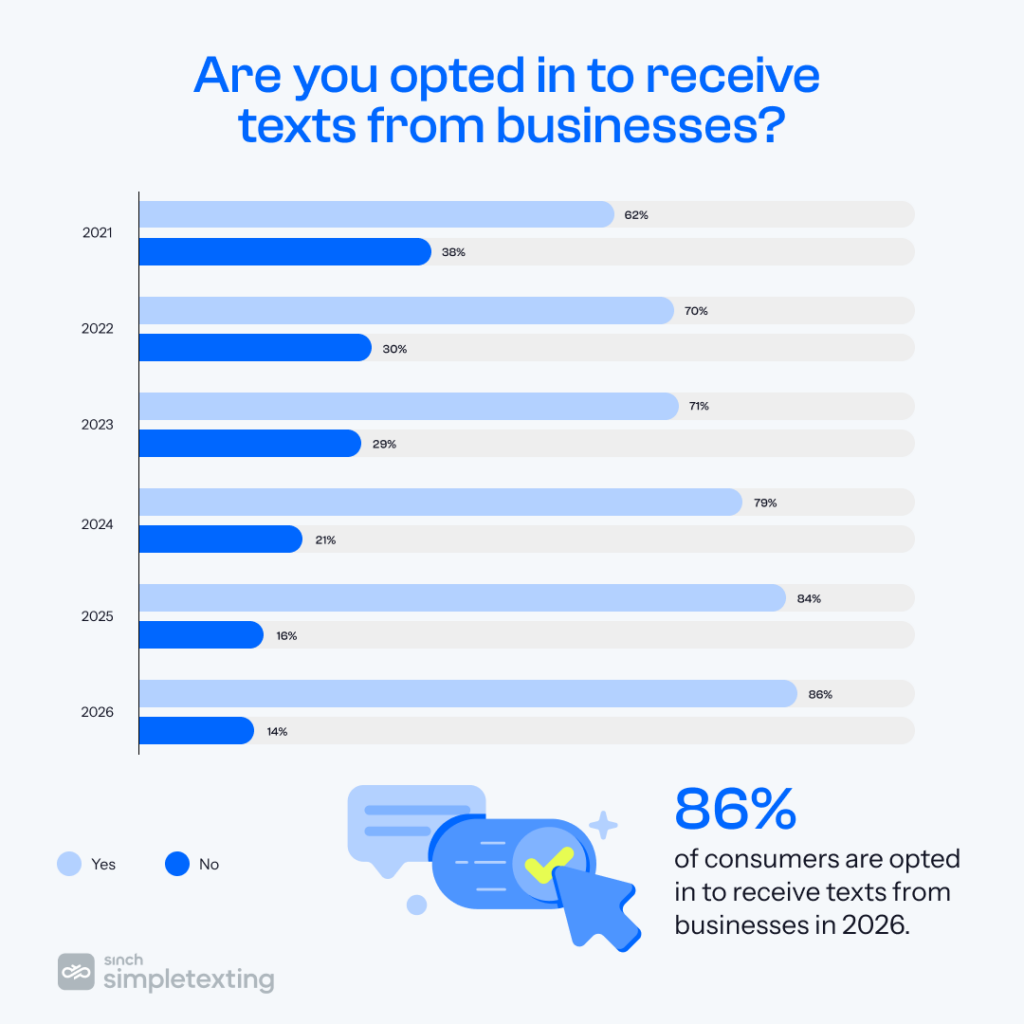
In 2026, 85.6% of consumers are opted in to texts from businesses – a nearly 40% growth from 2021.
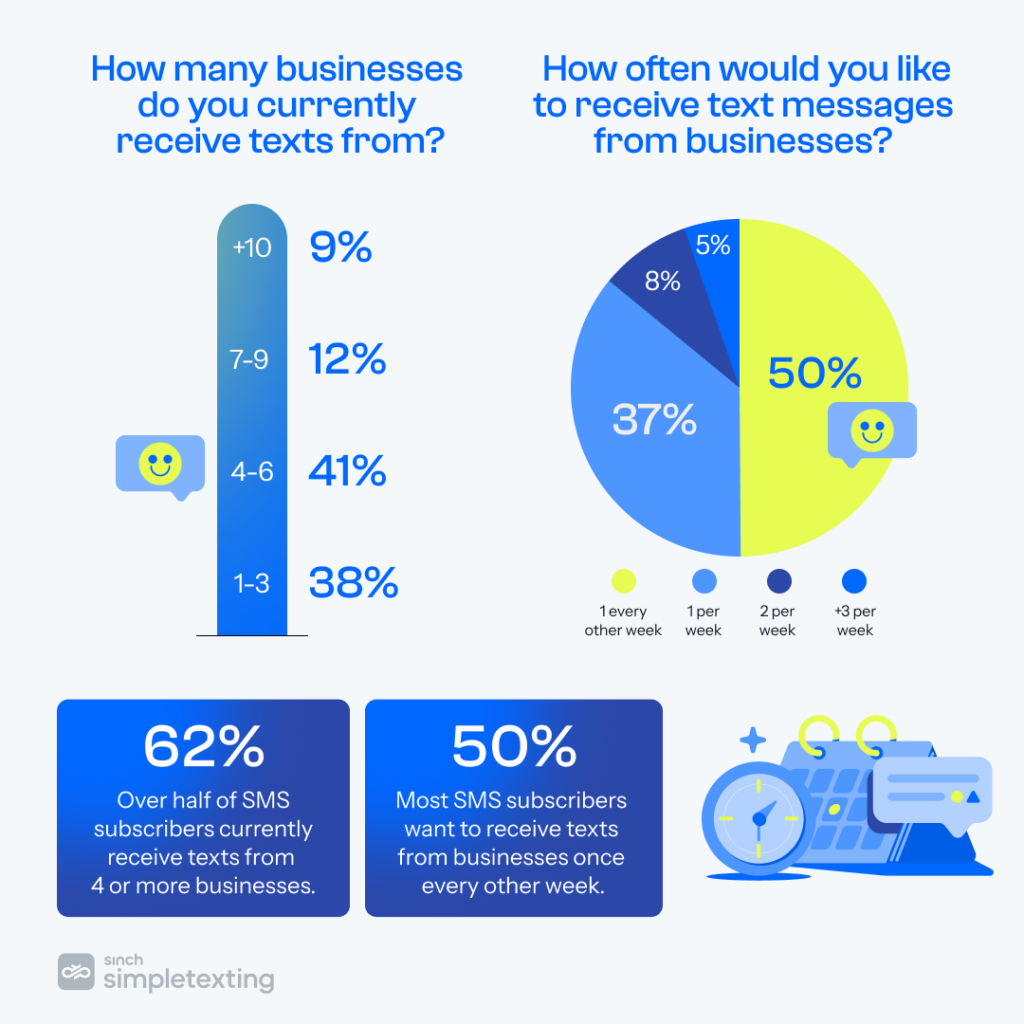
62% of consumers receive texts from four or more businesses.
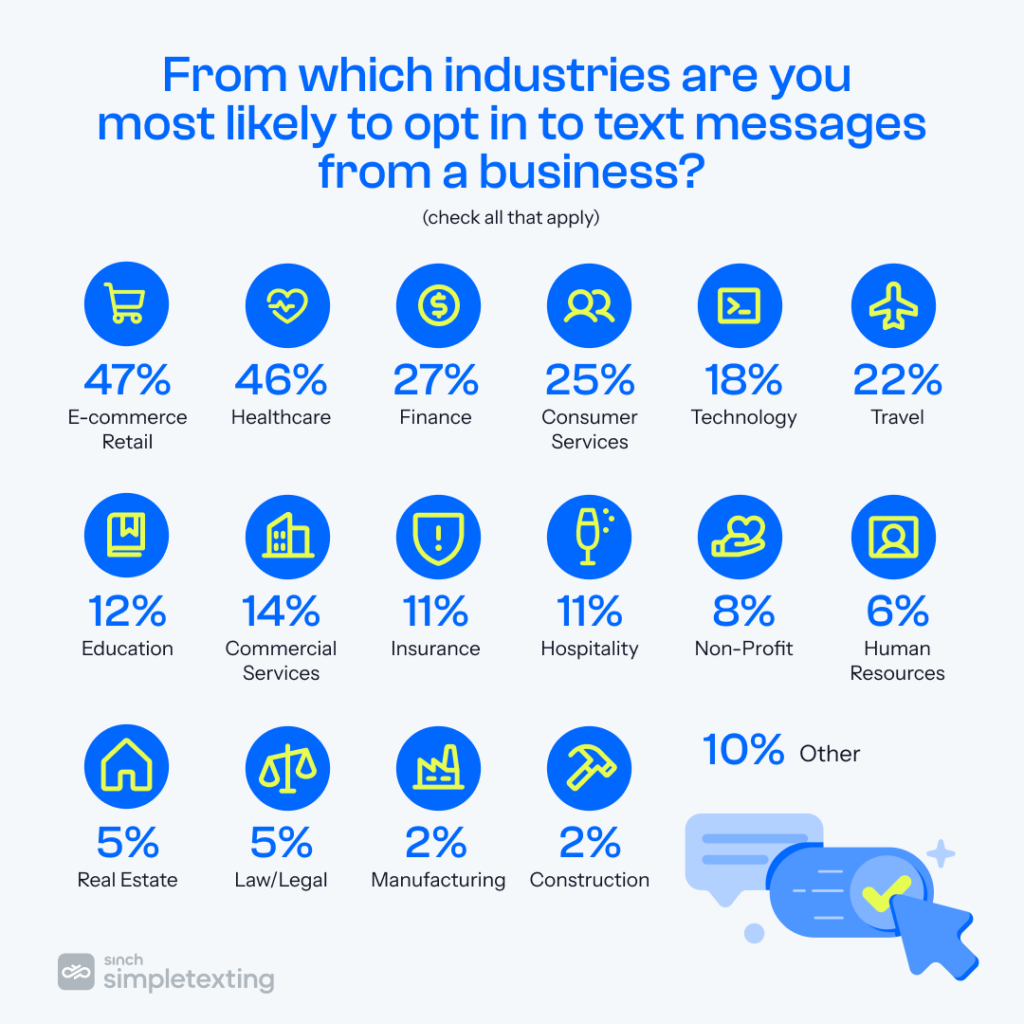
Consumers are most likely to subscribe to SMS lists from businesses in e-commerce/retail, healthcare, and finance.
Appointment/reservation reminders, shipment and order tracking, and promotions are the top reasons why consumers subscribe to SMS.
58% of consumers texted with an AI chatbot over the past year, while 11% can’t tell if they have or not.
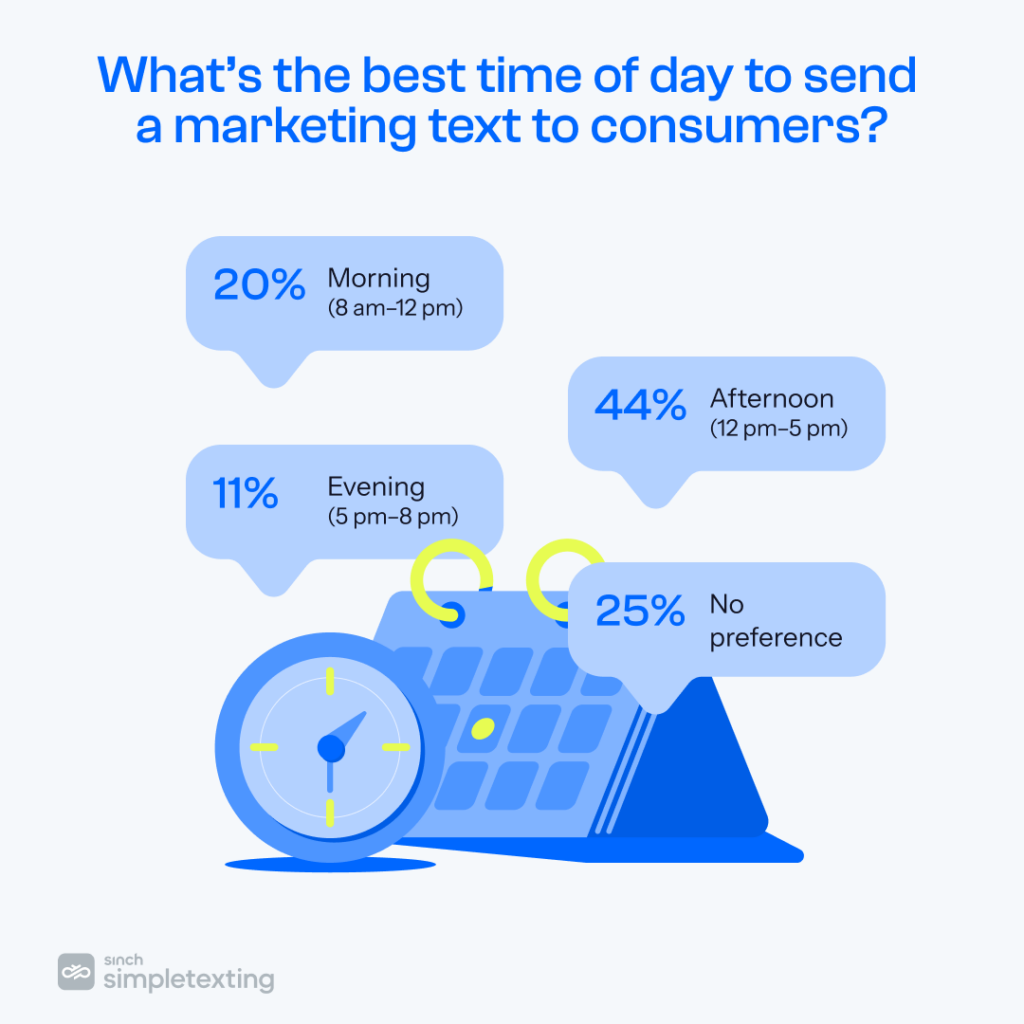
Most consumers (44%) prefer to receive texts in the afternoon between 12 pm and 5 pm.
Consumer-related text marketing statistics
How quickly do consumers check their text notifications?
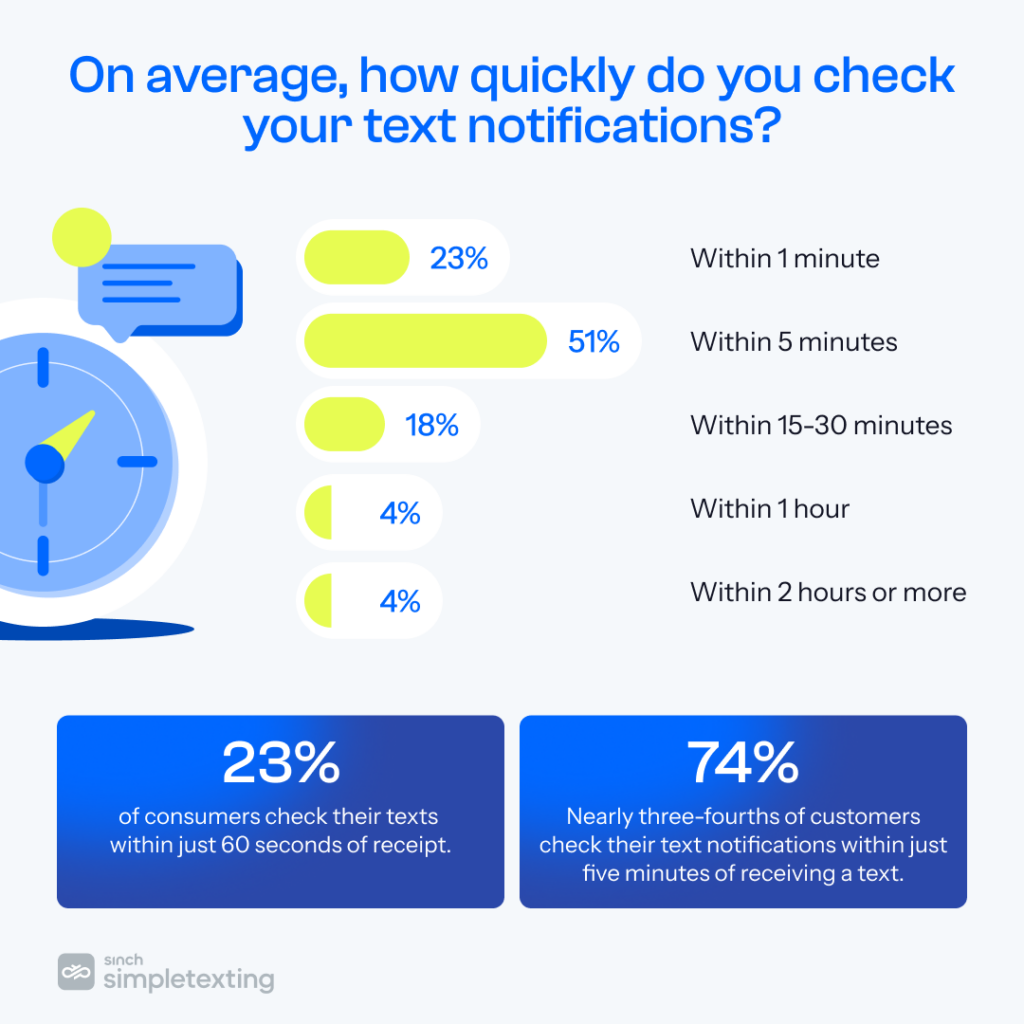
Most consumers check their texts incredibly soon after receiving them. 23% of consumers check their text notifications within just one minute of receiving a text. If we look at the data even further, you’ll see that nearly three-fourths of customers (74%) check notifications within five minutes of getting a text.
This is great news for businesses that invest in text message marketing. With most customers looking at their texts within minutes, SMS marketing gets its message across at lightning speed. And our reports from past years back up these trends.
How frequently do consumers check their texts in a day?
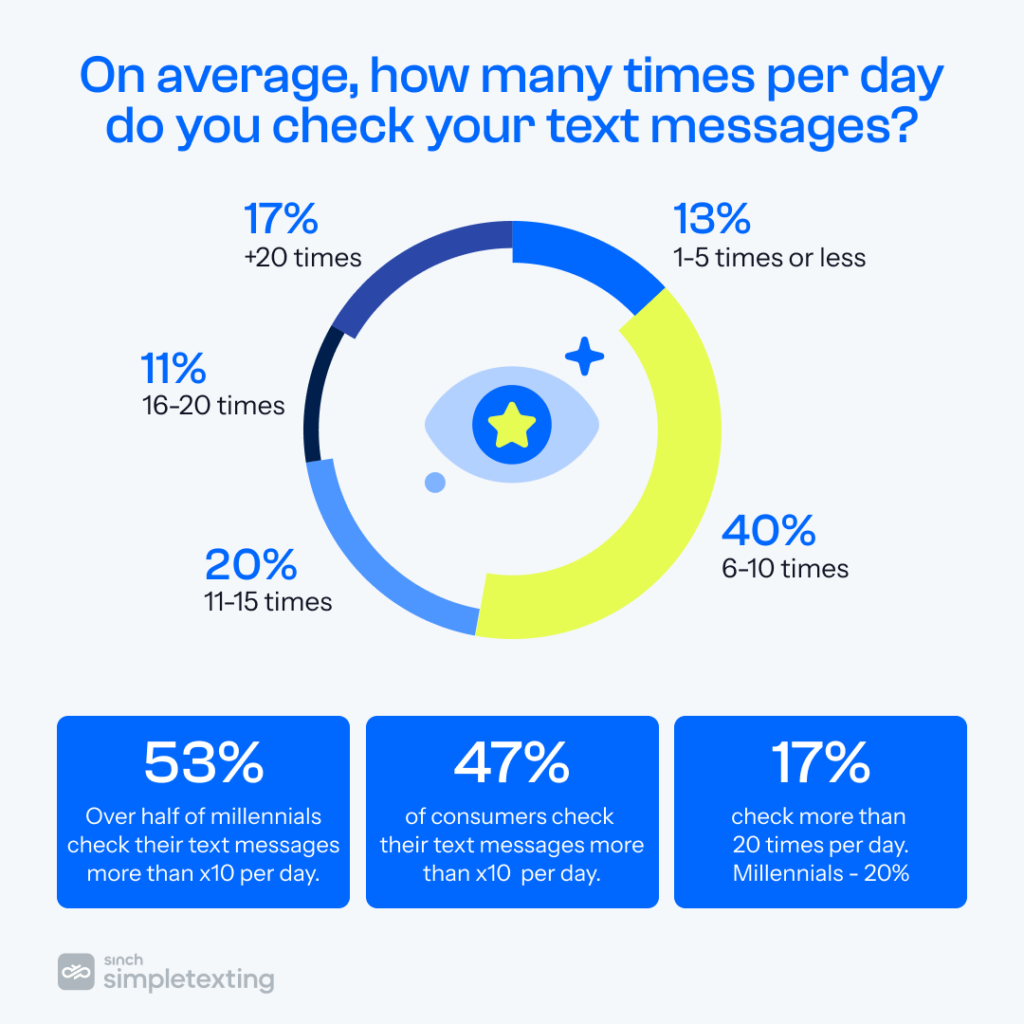
A quick notification-checking rate goes hand-in-hand with frequent checks throughout the day. Most consumers check for new texts numerous times every day. 47% of consumers check their text messages more than 10 times per day, and 17% check more than 20 times per day.
Millennials are especially in tune with their SMS inboxes. Over half of millennials (53%) check their text messages more than 10 times per day, and 20% check them more than 20 times per day. So, businesses that try to target this generation might find slightly faster click-throughs or responses.
With customers checking their phones so often, how often do they write texts themselves? 82% of consumers told us they text every day. And Gen Z is even more ready to text compared to other generations – 88% of this group sends texts every day.
How do consumers use their phones?
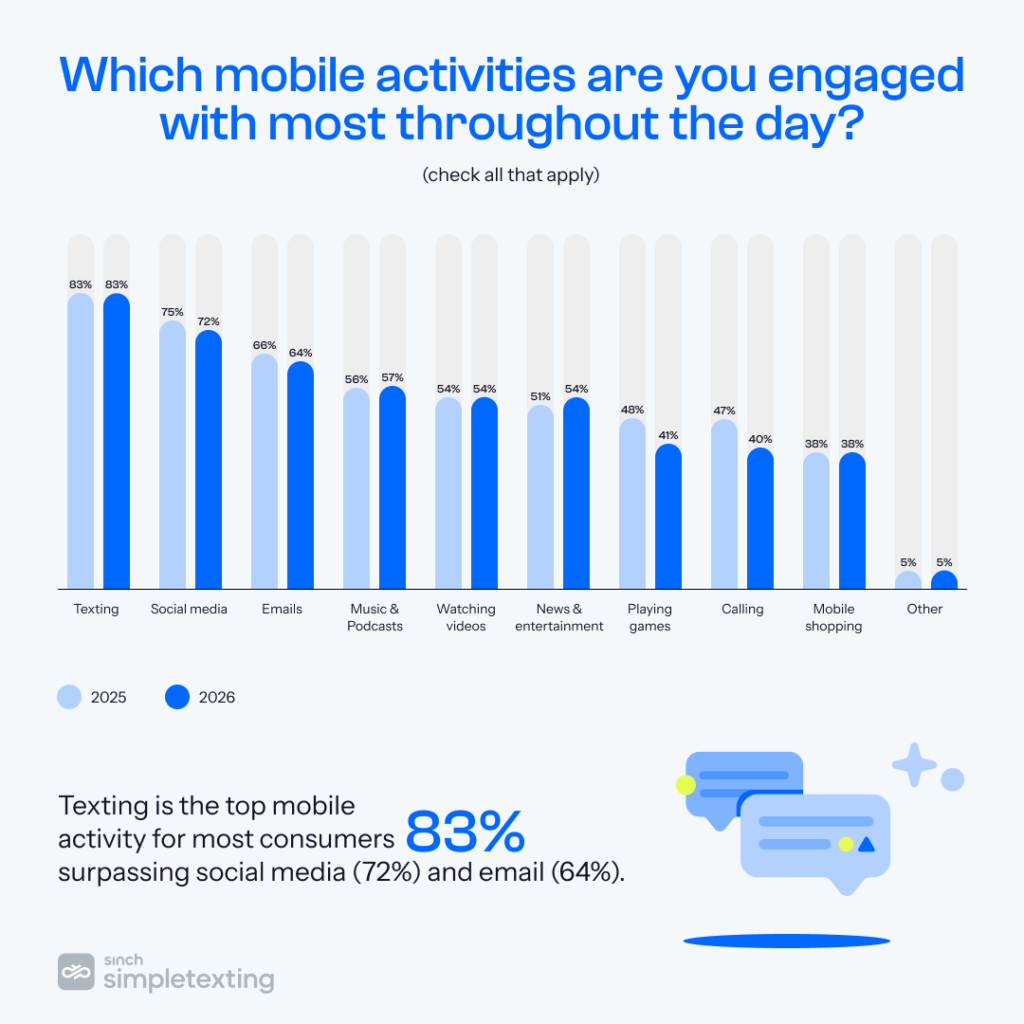
Even with the vast number of apps available on the modern smartphone, consumers often turn to texting first. 83% of consumers consider texting their top activity on their smartphones throughout the day. Compare this number to other popular activities like checking social media apps (72%), checking emails (64%), and listening to music/podcasts (57%).
This result is the same as 2025, but it aligns with an increasing trend since 2022. While texting was the top mobile phone activity for consumers throughout all of the surveys we conducted, 77% named it their top activity in 2022, and that number slowly increased over the years.
This ongoing pattern shows that even throughout a pandemic lockdown and the introduction of AI, texting persists. So, businesses that perform SMS marketing use a channel that holds up to the test of time.
How many consumers subscribe to business texts?
While so many consumers dedicate plenty of time to texting, does that interest translate to SMS marketing? This report’s data and yearly trends answer with an affirmative “yes.”
This year, 86% of consumers told us they are opted in to receive texts from businesses.
That’s a 2.4% increase from last year’s 2025 report, where 84% of customers reported being opted in to texts from businesses. The increase becomes more impressive when you look back at all the surveys we’ve conducted since 2021:
Comparing this year’s results to 2021, there was a nearly 40% growth in SMS marketing opt-ins since 2021. So, on top of texting being here to stay, SMS marketing keeps on growing.
Going back to this year’s results, there’s also a gendered difference in opt-in rates: More women (91%) are opted in to receive texts from businesses than men (77%). And when you look at opt-in rates by generation, Gen Z signs up for SMS marketing the most frequently, with 93% currently opted in to get texts from businesses.
How frequently do consumers like to receive text messages from businesses?
Consumers are overall receptive to receiving texts from multiple businesses. Most SMS subscribers (41%) opted in to texts from four to six businesses. Last year, most respondents were opted in to texts from one to three businesses, so consumers may be more open to subscribing to more companies’ SMS lists.
That receptiveness becomes clearer when you account for people who subscribe to even more text lists. 62% of SMS subscribers currently receive texts from four or more businesses overall.
But while consumers enjoy receiving text messages from a healthy variety of businesses, they’re sensitive to how often they get those texts. Most of them (50%) prefer to get texts from businesses once every other week, followed by 37% who say once a week.
If you’re new to SMS marketing, these cadences might surprise you. And the right cadence for your business might vary depending on your industry and audience. Try one of our go-to cadences, then adjust according to your texts’ performance and customer feedback.
What’s the best time of day to send a marketing text to consumers?
We commonly see SMS marketers wonder what the best time for sending a text is. So, we figured we’d ask customers ourselves. And the top time of day that customers prefer to receive a text message is the afternoon – specifically from 12 pm to 5 pm.
This time period also falls within federal and state guidelines for text messaging sending times in North America. The people and the law say it outright – text your customers during the day.
Which industries have the most SMS contacts?
When we asked consumers what industries they’re most likely to opt in to text messages from, e-commerce/retail (47%), healthcare (46%), and finance (27%) were the top answers. These three industries consistently take priority for consumers in our surveys, likely due to SMS marketing’s concise and fast nature.
For example, e-commerce stores count on SMS to push time-sensitive deals and create a sense of urgency. SMS helps healthcare providers send appointment reminders and communicate important health information quickly. And financial institutions use texting to keep accounts secure through two-factor authentication and security alerts.
That being said, some industries serve more niche markets than others. Even though real estate and human resources had fewer people showing interest, for instance, the people who do opt in to those lists have a very specific and important goal. Texting helps these people find homes and jobs, so even if there are fewer people subscribed, it still serves a helpful purpose.
Why do consumers opt in to SMS marketing?
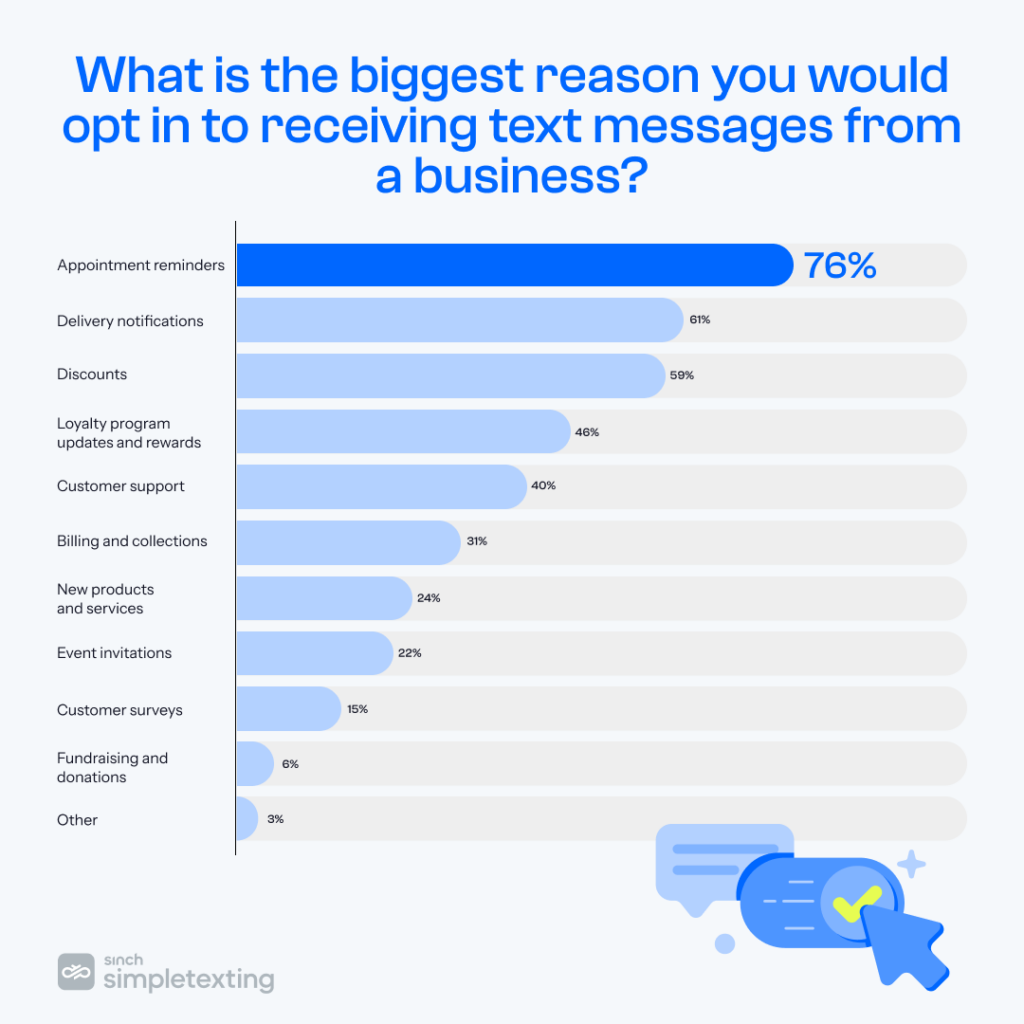
Consumers’ reasons for opting in to SMS marketing align with their preferred industries to receive texts from. They cite their three top reasons as appointment/reservation reminders (76%), shipment tracking/order status (61%), and promotions/sale alerts (59%). All of these responses involve time-sensitive information with bottom-line upfront details.
It also seems that consumers opt in to SMS marketing to improve their customer experience as well. Loyalty program and rewards updates (46%), and customer service/support (40%) are also high on the list. Perhaps consumers view subscribing as exchanging their inbox space for better customer perks.
How do consumers prefer to reach businesses for customer support?
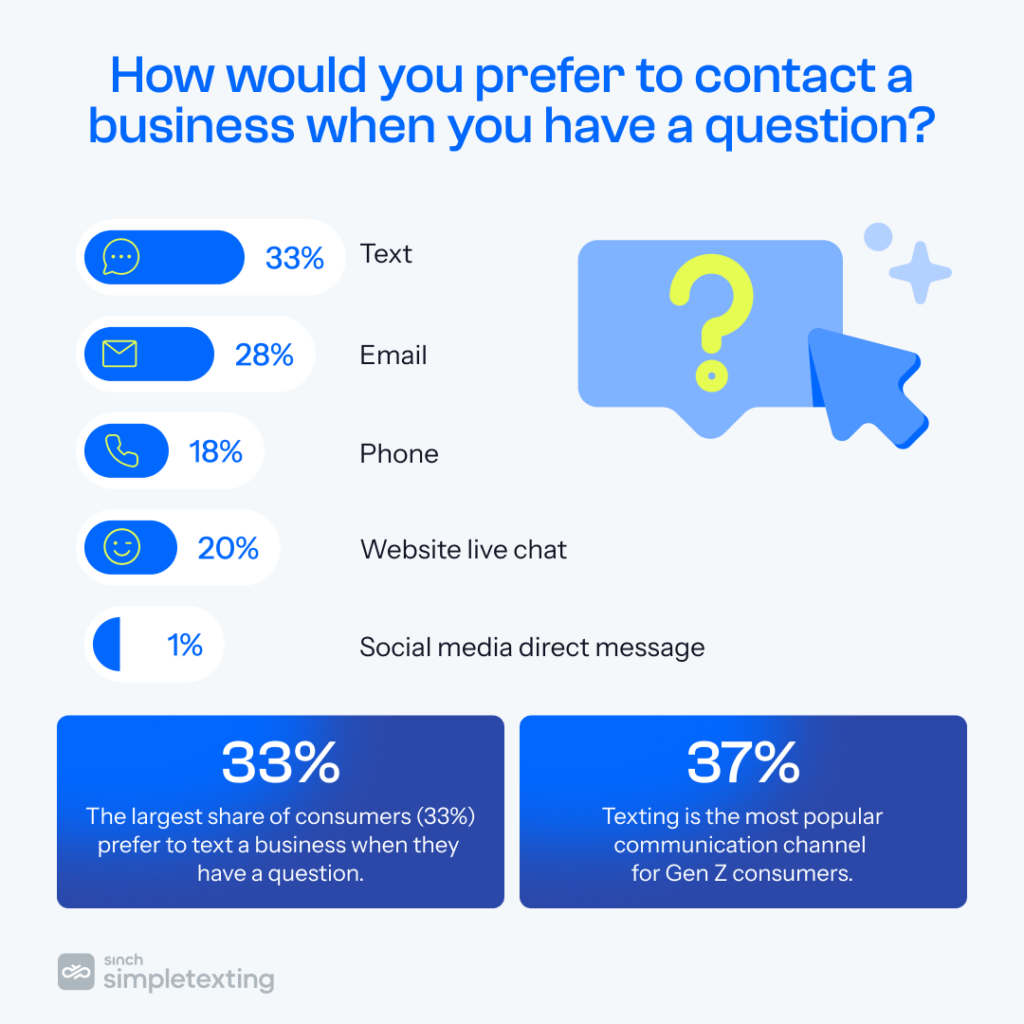
Compared to other options, consumers prefer to text a business (33%) when they have a question. Email (28%), website live chat (21%), and phone calls (18%) trail somewhat behind. SMS and email frequently got similar levels of interest when we asked this question in the last few years’ surveys, showing that SMS is an equally viable option for customer support.
This preference for texting increases for Gen Z. 37% of Gen Z consumers prefer to be able to send a text when they need customer support.
Customers prefer to be able to text a company back in any other situation, too. 64% of consumers say they want the ability to text a business back. And when you factor in generation, 72% of baby boomers and 66% of Gen X consumers say they want two-way messaging.
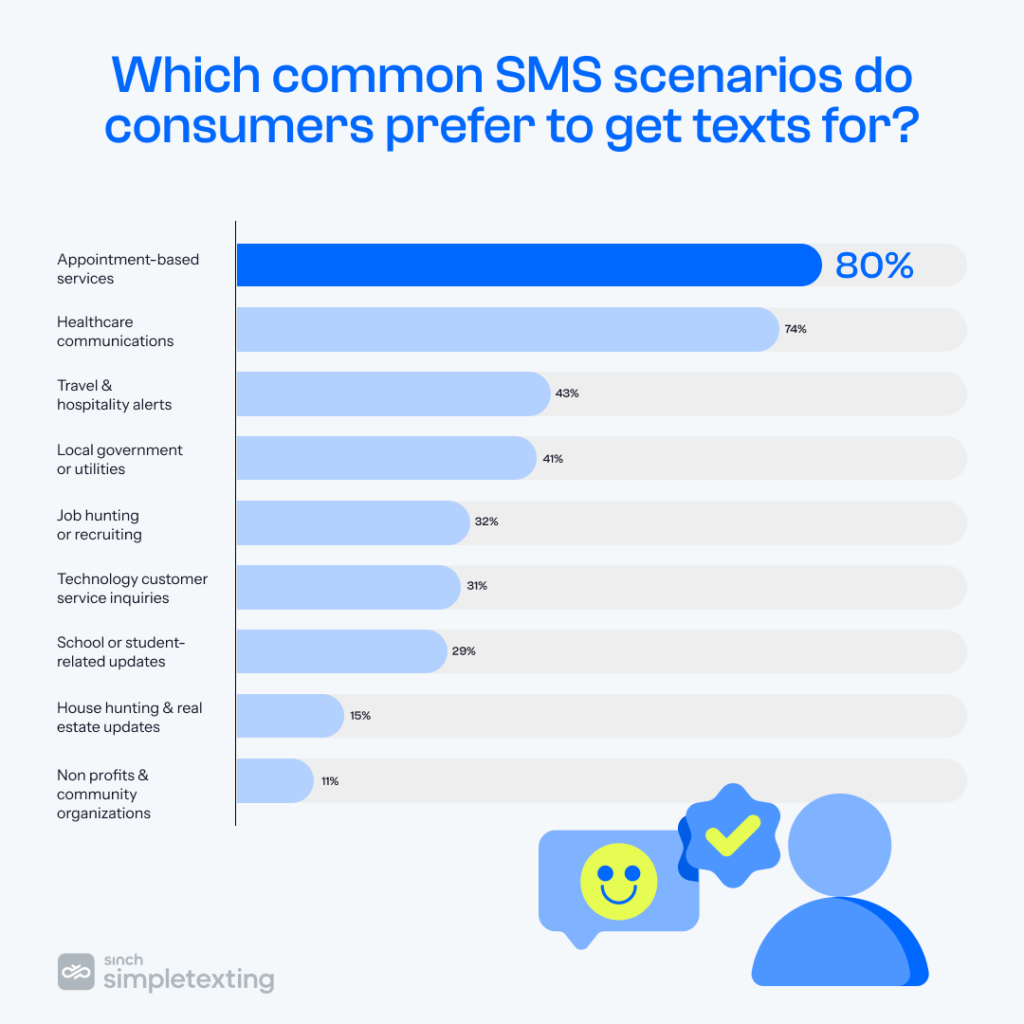
Which common SMS scenarios do consumers prefer to get texts for?
Certain industries have common texting use cases that suit the nature of their business, such as student updates in education or emergency alerts from utility services. These situations come up frequently enough that we decided to investigate these scenarios in this study.
When we presented consumers with the top scenarios they would prefer to get texts for, they overwhelmingly chose appointment-related reasons. 79.6% preferred to get texts about appointment-based services like salons, while 73.5% choose to get healthcare communications such as appointment reminders.
Why do consumers opt out of business texts?
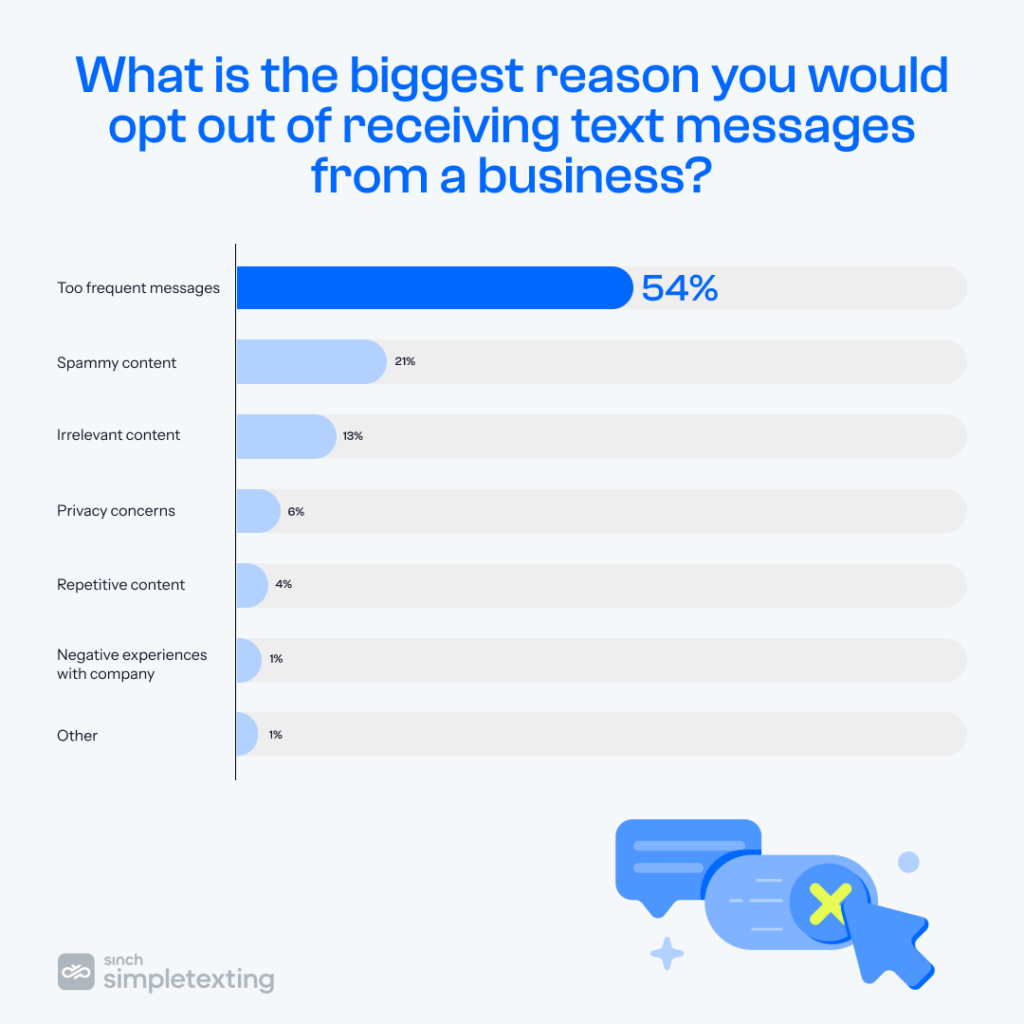
When faced with texts that don’t connect with their preferences or schedule, consumers choose to opt out. The main deal-breakers customers named for opting out of SMS lists were messaging too frequently (55%), spam-like content (21%), and messages that lack relevance (13%).
In other words, the texts they received overstepped their boundaries. You can reduce opt-outs related to these reasons by creating a clear opt-in message and sticking to it. Follow the guidelines you promised your subscribers, and they’ll be more likely to stick around.
SMS marketing insights from businesses
What percentage of businesses use SMS marketing in 2026?
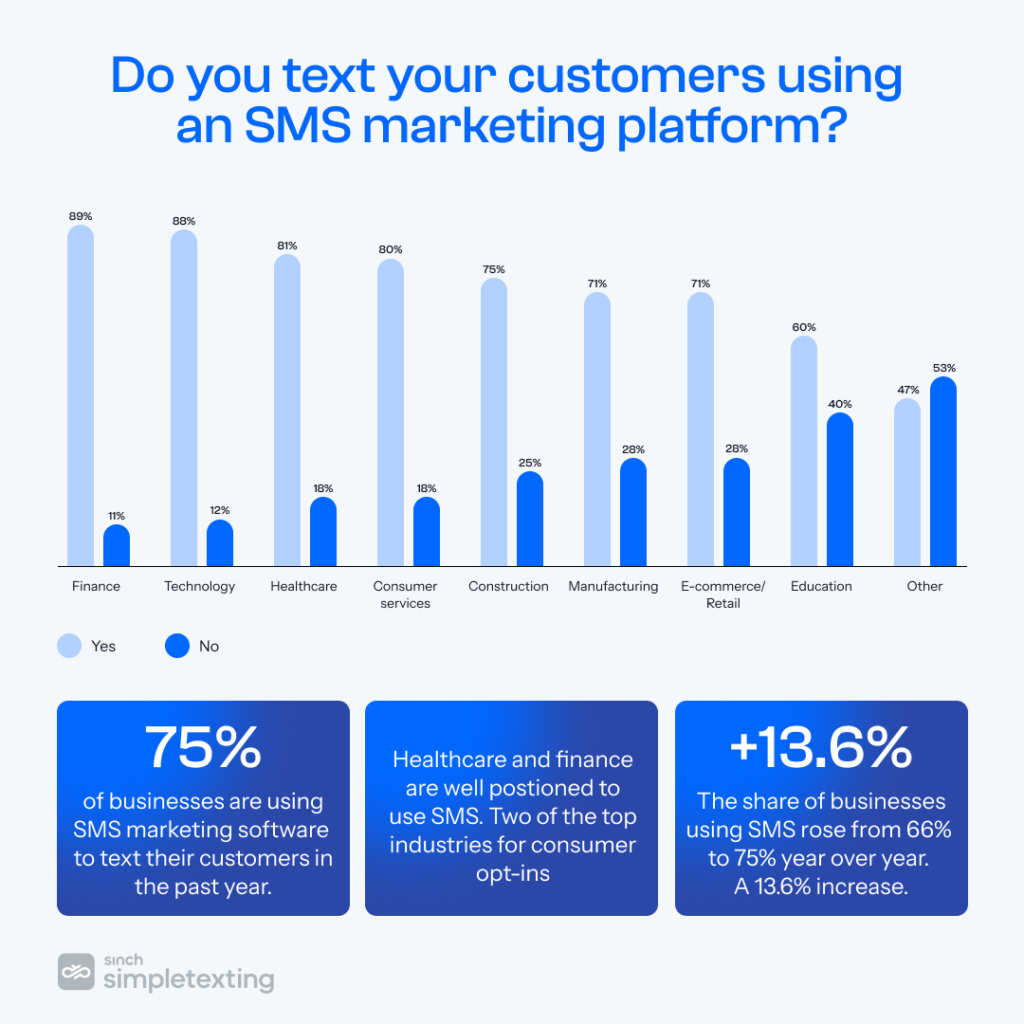
Text message marketing grew in 2025, with 75% of businesses using SMS marketing software to text their customers at the start of 2026. Compare this number to last year, where 66% of businesses reported texting their customers. This year’s finding is an impressive 13.6% increase from last year.
The industries most likely to text their customers were finance (89%), technology (88%), healthcare (82%), and consumer services (80%). Note how finance and healthcare also appeared in the top industries that customers subscribe to texts from. Between both of these trends, the finance and healthcare industries are well-positioned to use SMS marketing.
How does SMS marketing affect overall marketing success?
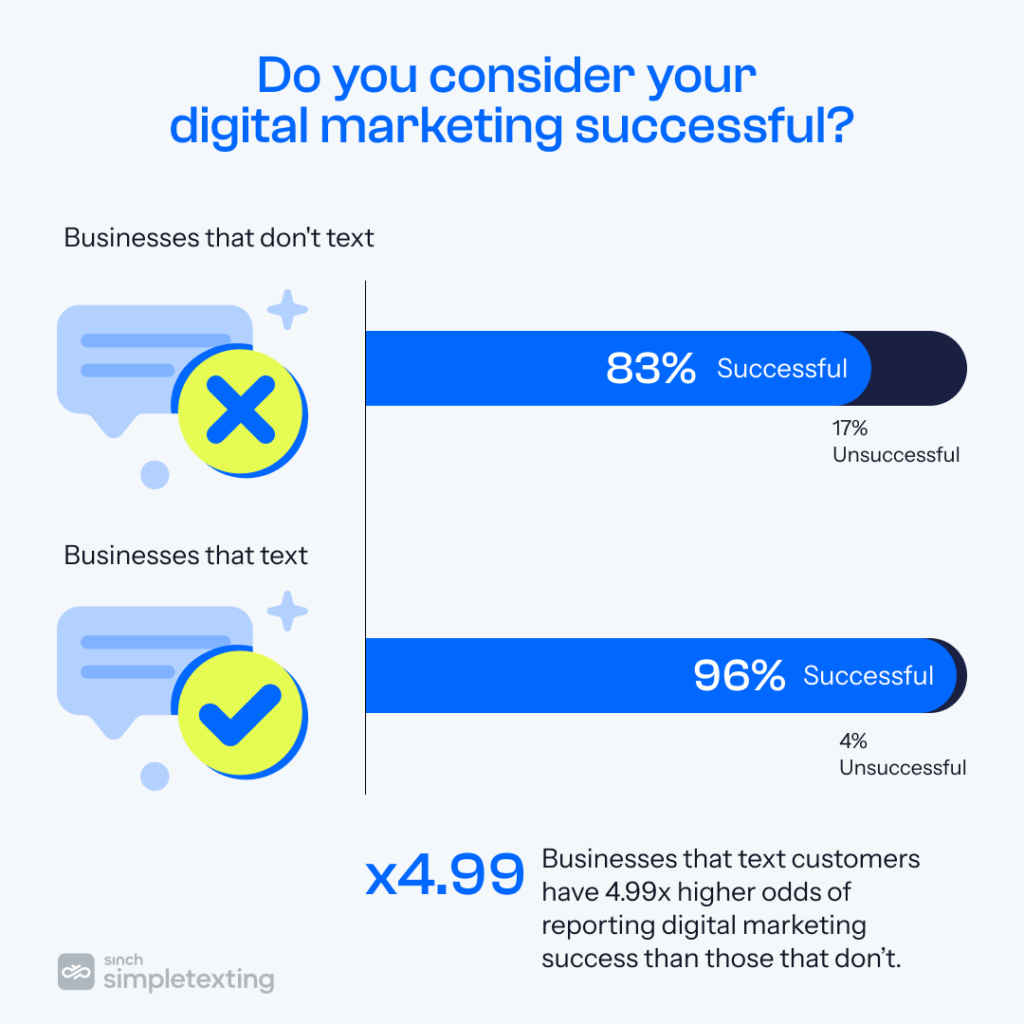
SMS marketing has a positive effect on overall digital marketing. 96% of the businesses that reported they use SMS marketing consider their digital marketing efforts successful. Comparatively, 82.8% of businesses that don’t text say the same.
Looking at both results, businesses that text customers are 16% more likely to report digital marketing success than those that don’t. And businesses that text customers have 4.99 times higher odds of reporting digital marketing success than the other group.
How successful is SMS marketing?
On top of contributing to successful digital marketing overall, SMS marketing itself creates meaningful results. The businesses that took part in our survey had high click-through rates (CTRs) and low unsubscribe rates, showing that recipients engage with texts.
Let’s look at CTR first.
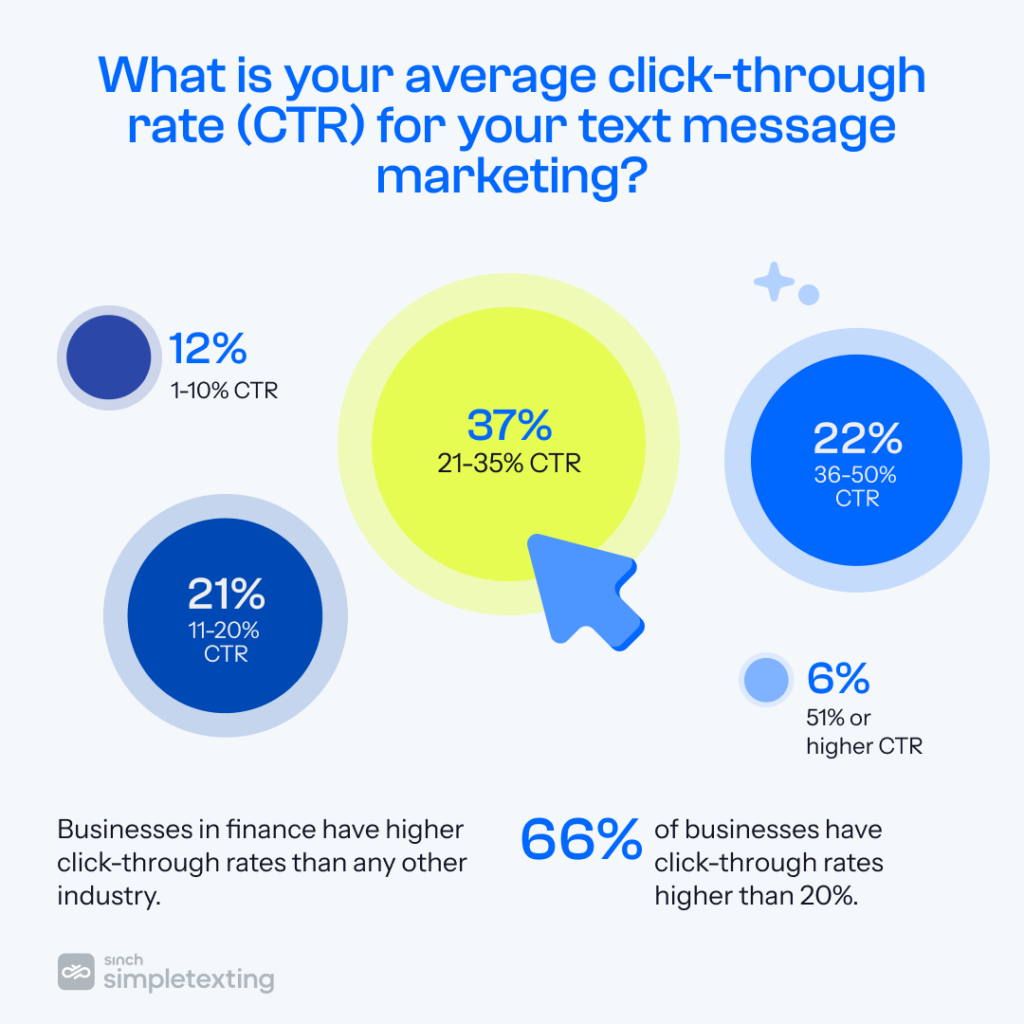
The largest share of businesses (37%) has an average text message CTR between 21 and 35%. Zooming out a bit, 66% of businesses have CTRs higher than 20%.
When you break down CTR by industry, businesses in finance, healthcare, and education have the highest average rates. 80% of businesses in finance, 77% of businesses in healthcare, and 71% of businesses in education see average click-through rates higher than 20%.
As for opt-out rates, most businesses don’t see very many unsubscribes. The largest share of businesses (30%) has an average SMS marketing unsubscribe rate between 1 and 2%. And overall, 45% of businesses have an average unsubscribe rate of 2% or lower.
What are the most common uses for SMS marketing?
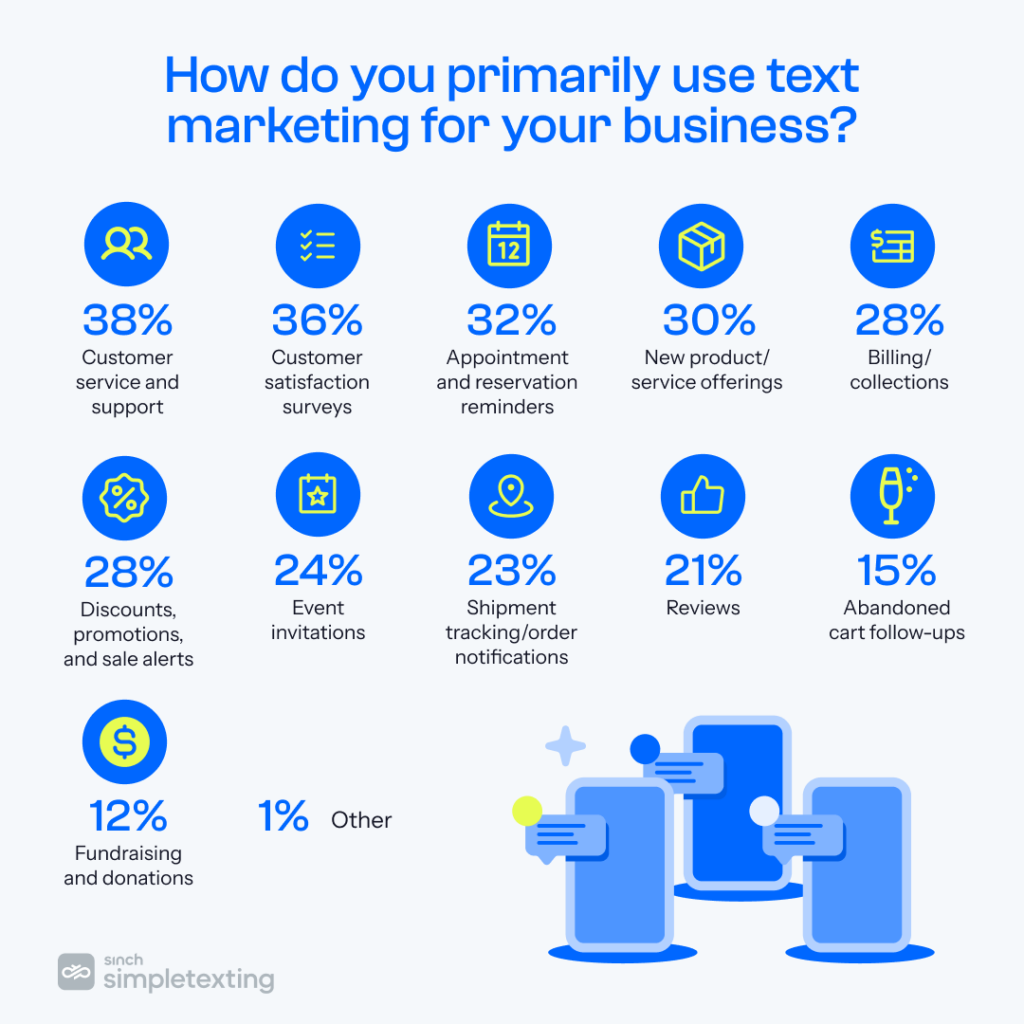
While your first association with SMS marketing might be promotional texts, businesses actually prefer to use SMS to connect with customers. This year, customer service/support (38%) and customer satisfaction surveys/feedback (36%) are the top two SMS marketing use cases for businesses.
These findings line up with the results we saw in our two annual surveys before this one. Businesses count on texting as a quick and direct way to assist customers and improve their overall experience.
Why do businesses invest in SMS marketing?
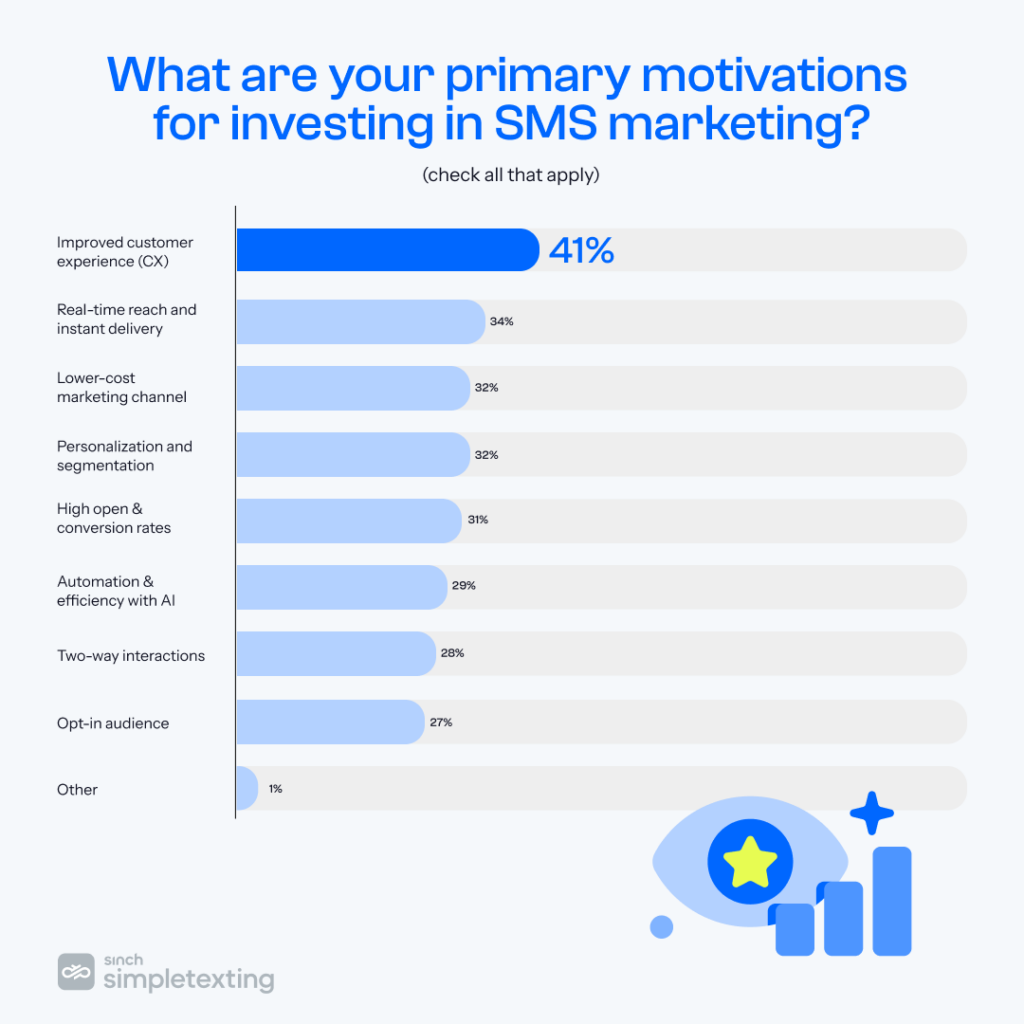
Businesses’ motivations for investing in SMS marketing align with their main uses for it. The largest share of businesses (41%) considers improved customer experience (CX) their top reason for using SMS marketing. Looking back at our discovery that businesses use texting for customer support and feedback, it seems they value texting as an avenue for connection with customers.
But the convenience of SMS marketing technology doesn’t hurt, either. The other top reasons businesses named for using it included real-time reach and instant delivery (34%), cost-effectiveness (32%), and personalization/segmentation capabilities (32%). These benefits allow for faster and more meaningful customer connections at an accessible price point.
How do businesses plan to adjust their text marketing budgets in 2026?
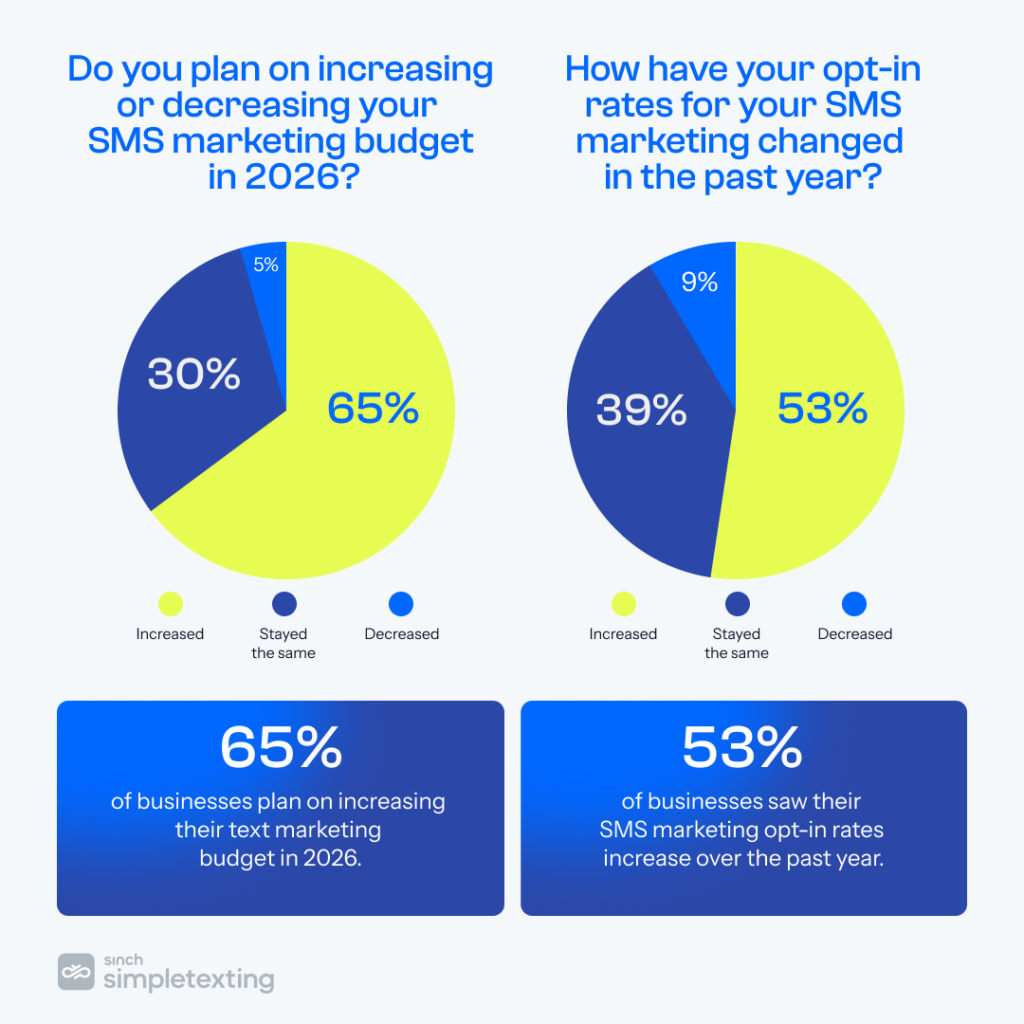
Most businesses want to invest even more money in SMS this year, showing that decision-makers believe in its ability to get results. 65% of businesses plan on increasing their text marketing budget in 2026.
This willingness to increase SMS marketing budgets reflects the channel’s success in driving important metrics. 53% of businesses saw their SMS marketing opt-in rates increase over the past year. Plus, the biggest share of businesses (31%) say text marketing contributes to 21-30% of their online revenue, and 76% of businesses say text marketing is either “effective” or “very effective” at driving revenue.
What SMS marketing technologies do businesses plan to use in 2026?
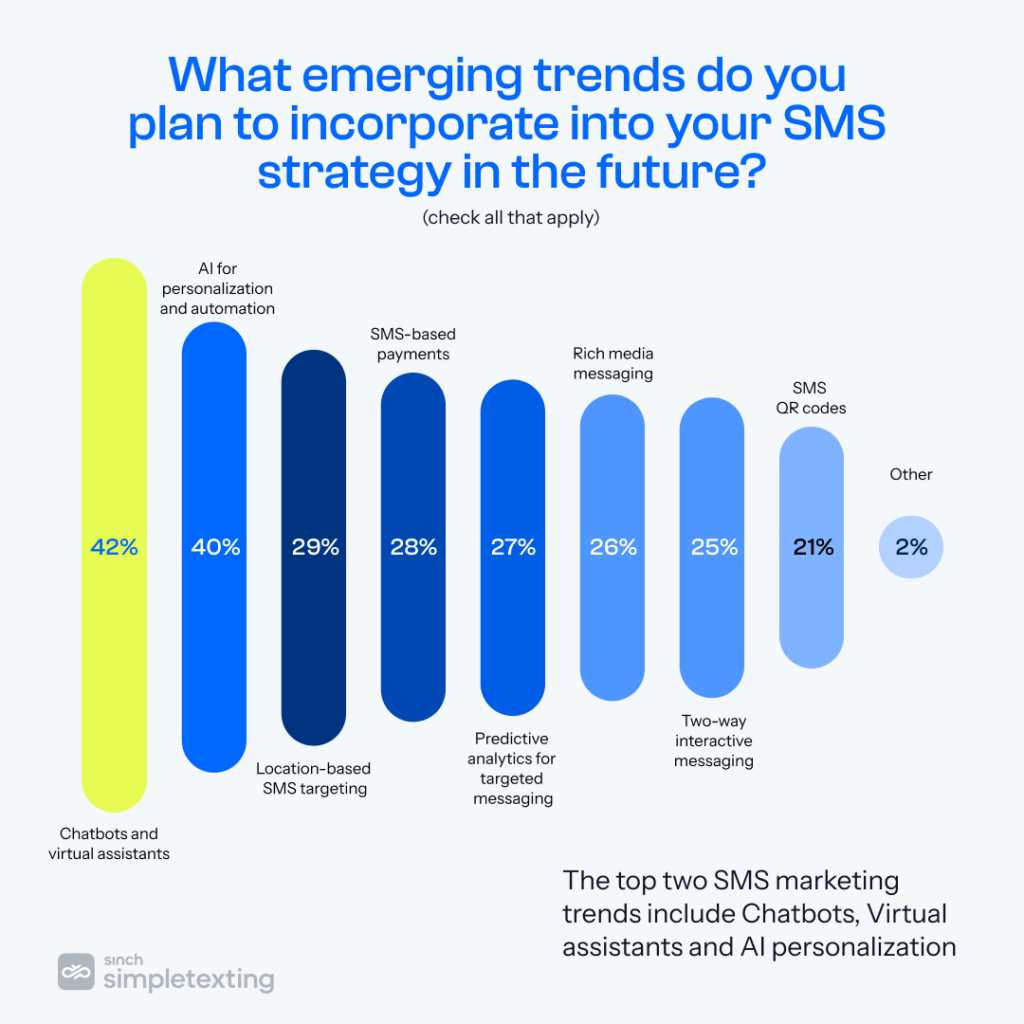
The most notable marketing trends that businesses want to use in their 2026 text marketing strategies relate to AI. Businesses’ two top picks were chatbots and virtual assistants (42%) and artificial intelligence (AI) for personalization and automation (40%).
Other top trends include location-based SMS targeting (29%) and SMS-based payments like text-to-buy (28%). These technologies make SMS more relevant and convenient for customers.
What challenges do SMS marketers face in compliance?
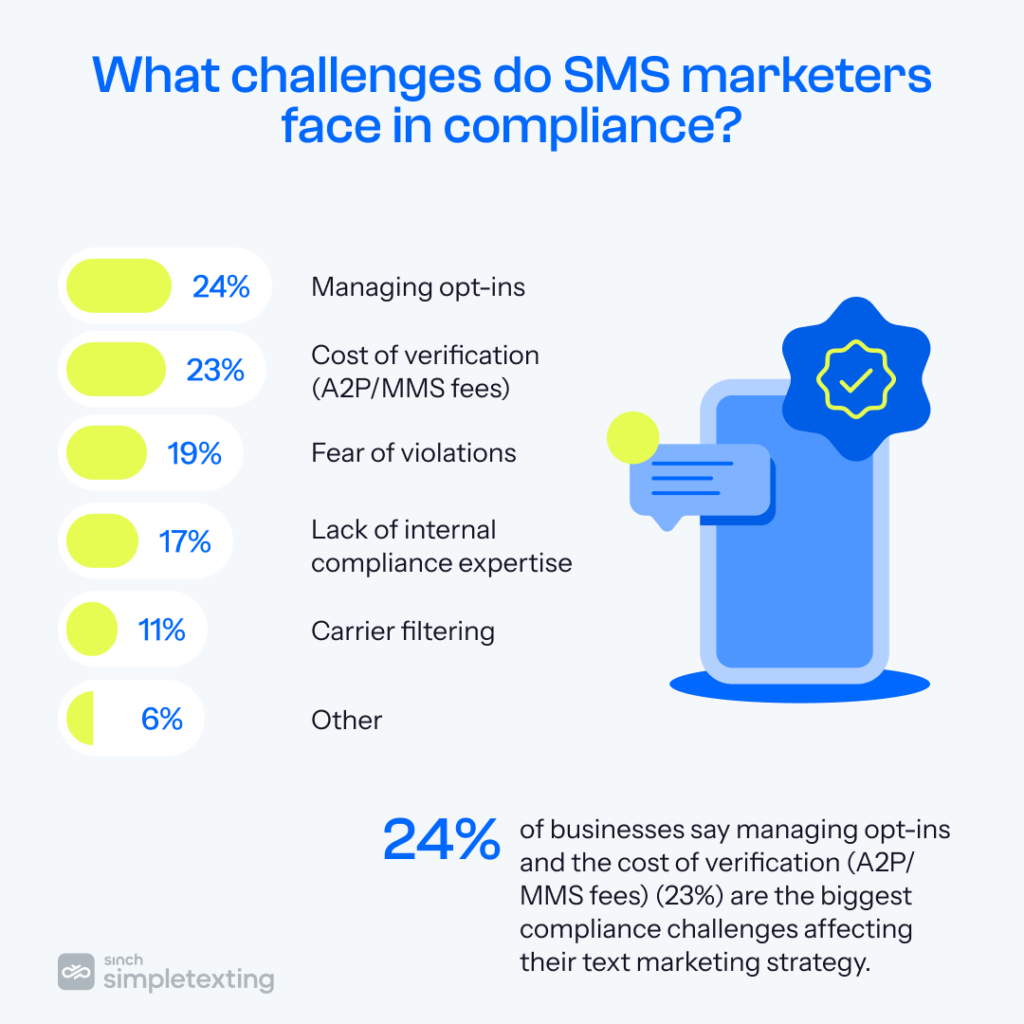
Compliance is one of the biggest learning curves for businesses getting into SMS marketing. And even companies with experience can have trouble keeping up with the latest regulations. When we asked survey participants about their biggest compliance challenges, most businesses named opt-in management (24%) and the cost of verification (A2P/MMS fees) (23%) as their top issues.
If you relate to these answers, SMS marketing platforms like SimpleTexting that streamline these processes can help. Look for a solution with double opt-ins and clearly outlined fees.
Which platforms do businesses integrate with SMS?
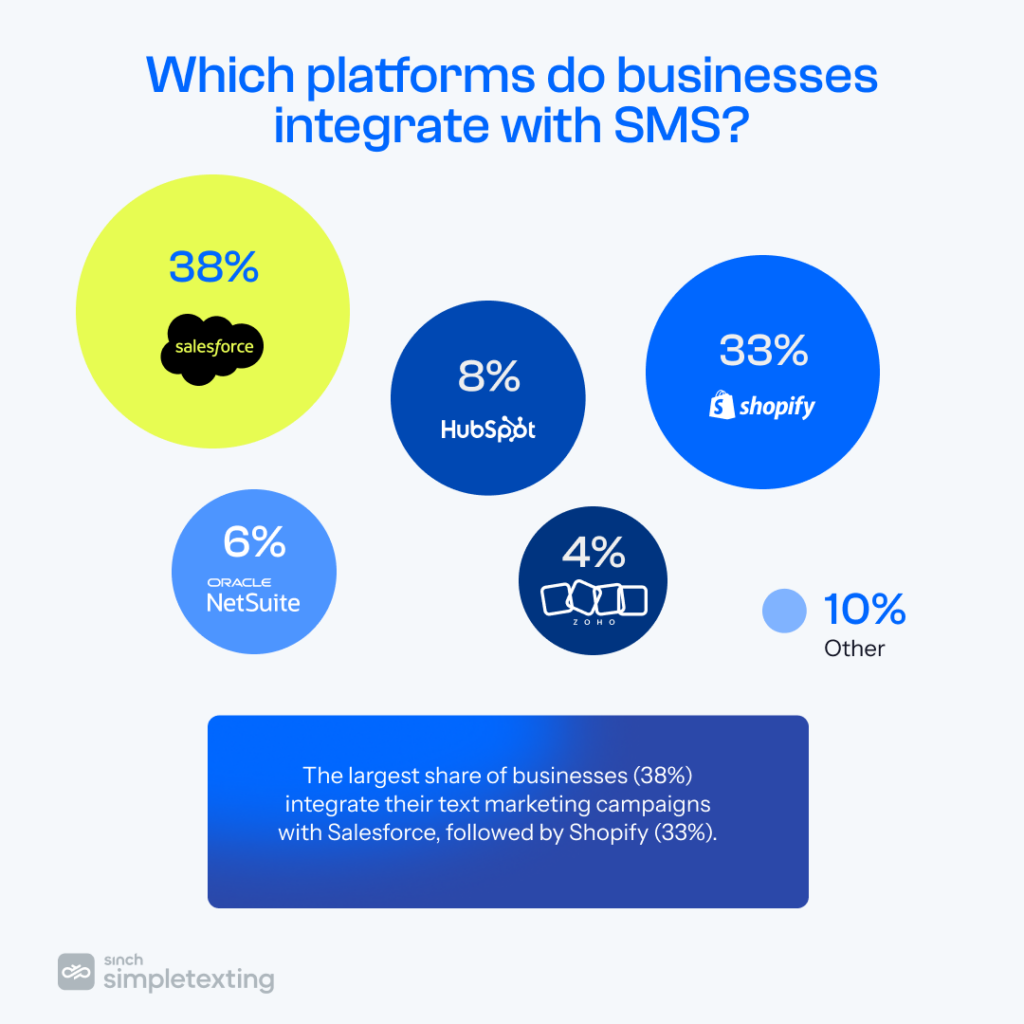
Many businesses use SMS as one step of a greater workflow. Because of this trend and integrations’ effectiveness in improving reach and conversions, we gauged interest in the types of integrations businesses want to see. Among the companies we surveyed, most (38%) would like to integrate their text marketing campaigns with Salesforce, followed by Shopify (33%).
Statistics on AI and SMS marketing
How often do consumers interact with AI chatbots over SMS?
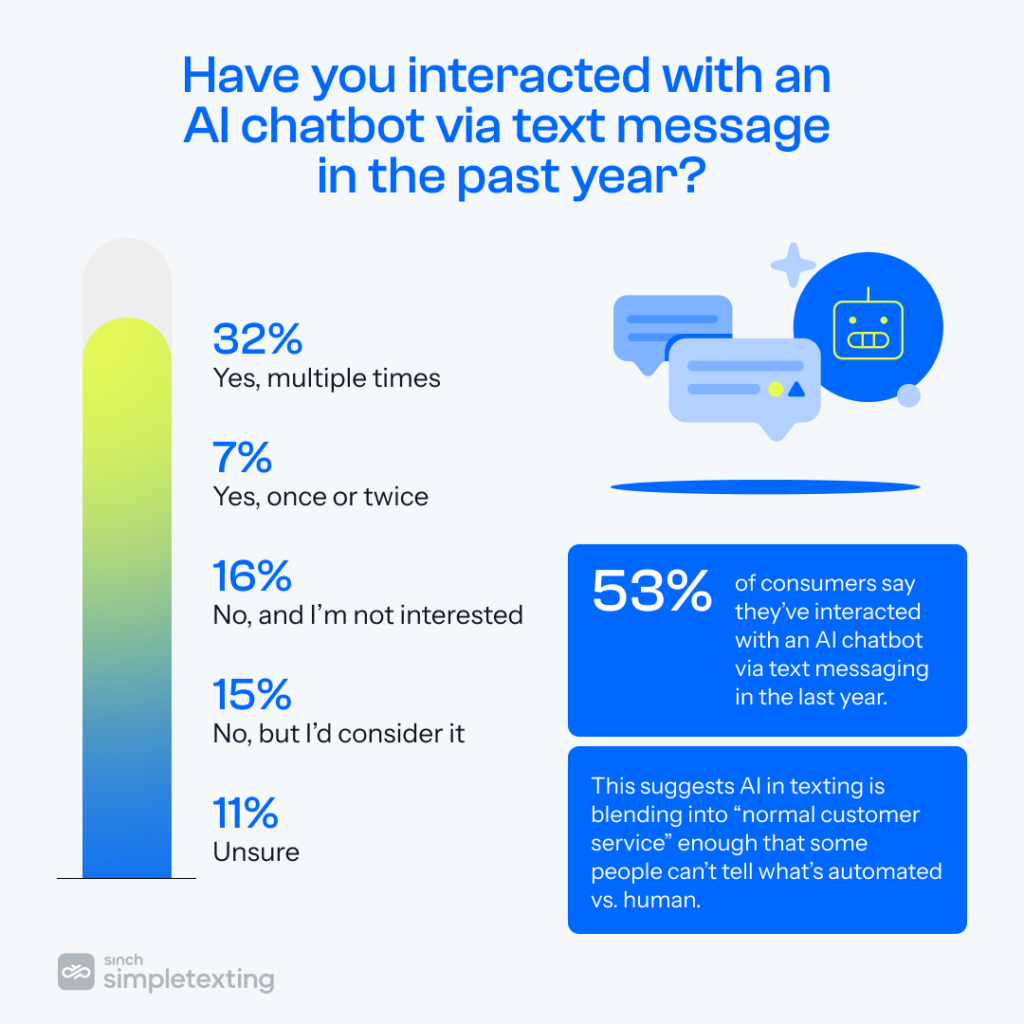
Our earlier results showed that AI chatbots are one of the top technologies businesses use in SMS marketing, and consumers are noticing that trend on their side of the SMS list. Throughout 2025, 32% of consumers interacted with an AI chatbot over text once or twice, and 26% had these conversations multiple times. That totals 58% of consumers who interacted with a chatbot over text in the past year.
An even more fascinating insight comes up when you see that just over one in 10 consumers aren’t sure whether they’ve texted an AI chatbot or not. These answers suggest that AI texting is blending into standard customer service enough that not everyone can tell what’s automated or human.
What factors would make consumers more comfortable texting AI chatbots?
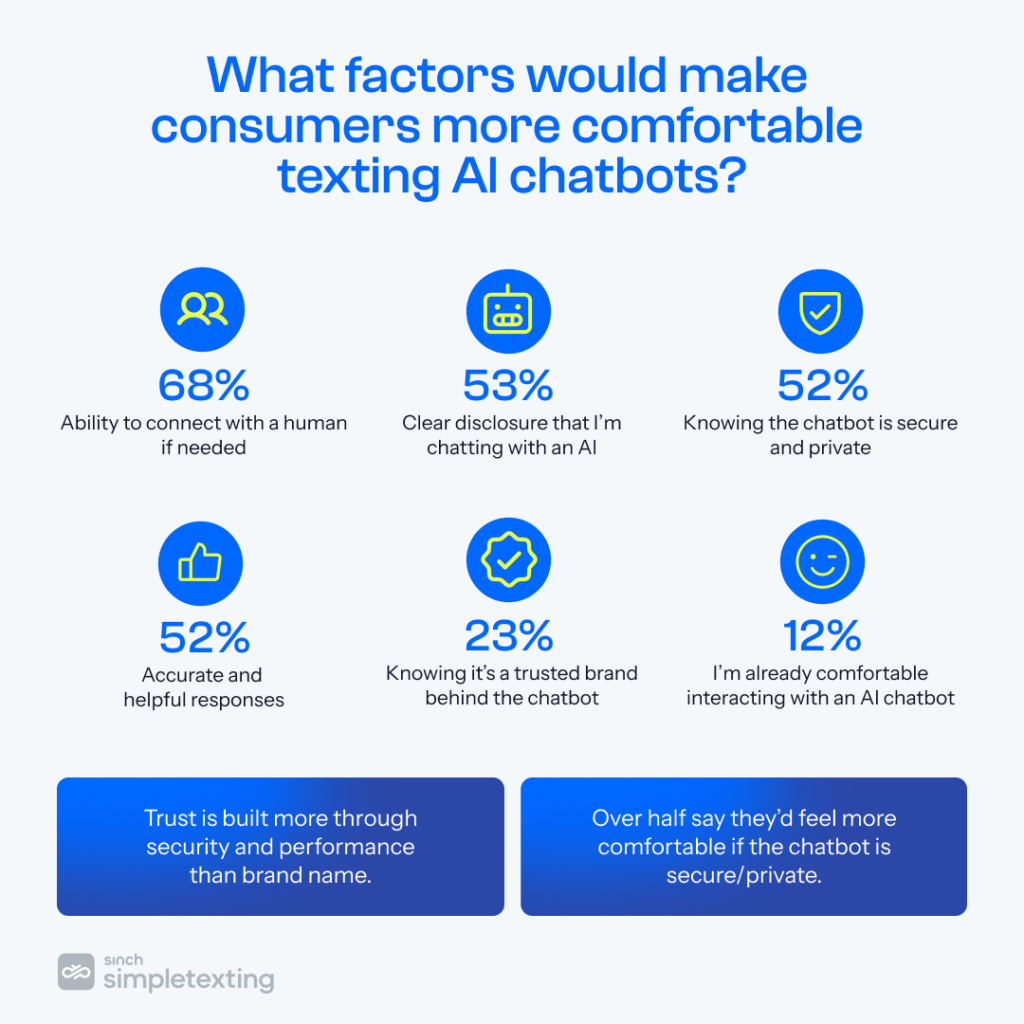
So, with some customers not even sure how to distinguish AI texting from human texting, what can businesses do to build their trust? Most customers want to be able to reach a human if needed 68%, and just over half want clear disclosure that they’re texting with AI (52.5%).
Looking at the other potential responses to this question, it becomes clear that businesses build trust in chatbots through security and performance over brand name. More than half of customers would feel more comfortable having a secure or private chatbot (52.2%) and accurate or helpful (52.1%). But only 23.4% think that knowing the bot comes from a trusted brand is a comfort driver.
How does AI impact text message marketing success?
Regardless of the potential pitfalls surrounding AI chatbots and trust in customers, AI contributed to many businesses’ text message marketing success in 2025. 71% of businesses say AI has improved the performance of their SMS marketing campaigns. And within that 71%, over a quarter of businesses (27%) say AI has significantly improved the performance of their SMS campaigns.
How do businesses use AI in SMS marketing?
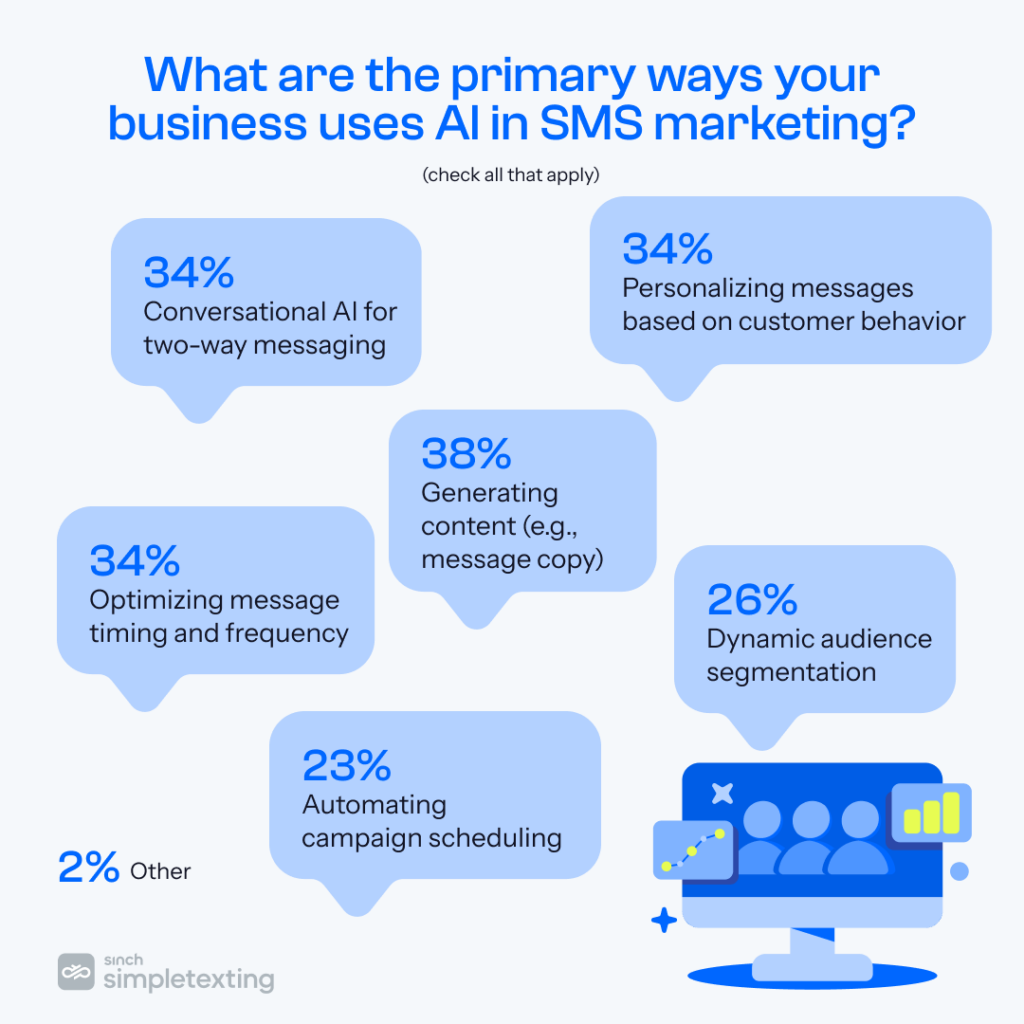
Businesses use AI in various aspects of SMS marketing. Most mainly use it for generating content like message copy (38%), two-way messaging powered by conversational AI (34%), and optimizing message timing and frequency (34%). From finding the right time to text to responding to customer replies, businesses find helpful use cases for AI tools.
Does AI save marketers time on text marketing?
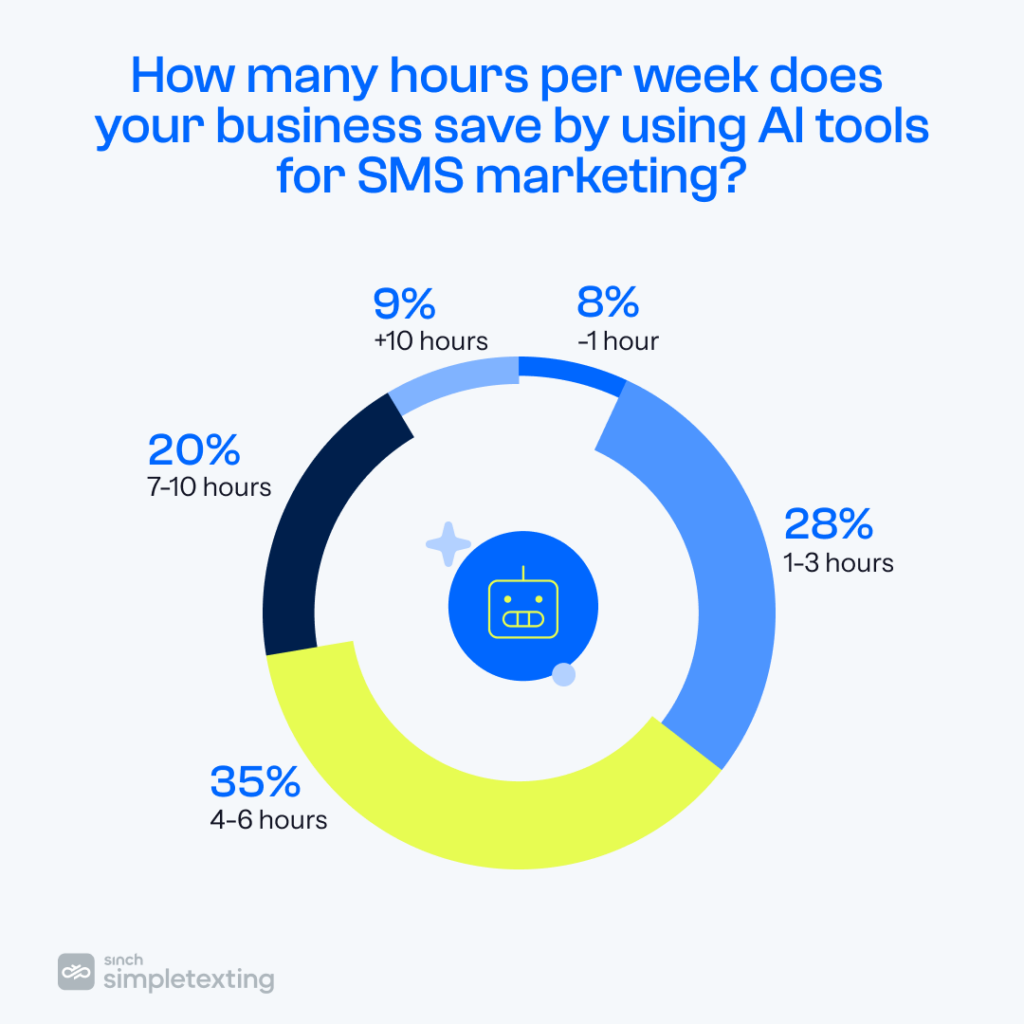
AI SMS marketing can save businesses about half a day’s worth of work per week, according to the businesses we surveyed. 64% of businesses say using AI tools for their SMS marketing campaigns saves them four or more hours per week. The biggest share of businesses (35%) say it helps save four to six hours per week, on average.
What comes next for SMS marketing?
Throughout the 2020s, SMS established itself as an essential marketing channel alongside staples like email and web. Now, it continues to grow, with three-quarters or more of businesses and consumers using or consuming SMS marketing. But with great power comes great responsibility.
Trust and transparency will be critical as SMS emerges from its growing stage and joins the world of AI. Businesses often count on SMS to build rapport with customers, but customers need trust to continue with AI chatbot texting. Some customers simply want to be able to tell what’s AI and what’s not.
In 2026 and beyond, savvy businesses will stay in tune with customer needs and technological advances. Check out our success stories and small business podcast for real stories of businesses using texting to bridge the gap between business and consumer. You can also try our texting platform for free to see how automations and built-in compliance features can improve your customers’ experience.
Methodology
The statistics in this report come from two separate surveys. We surveyed 1,000 U.S. consumers and 400 U.S. business owners and digital marketing managers from January 7th to January 8th, 2026. View SMS marketing statistics from previous years: 2024, 2025
The top three reasons consumers opt in to SMS marketing are appointment/reservation reminders (76%), shipment tracking/order status (61%), and promotions/sale alerts (59%).
71% of businesses report that AI has improved their SMS marketing success, with over a quarter (27%) stating it significantly improved performance. AI also saves businesses an average of four to six hours per week on SMS marketing tasks.
SimpleTexting exists to help businesses make an impact with the most reliable and straightforward way to reach people – by text message. Sign up for a free trial today.
It's a new year and that means new text marketing trends in 2024. Get our firsthand insights on what your customers want and how to give it to them here.
Start a text marketing campaign or have a 1-on-1 conversation today. It's risk free. Sign up for a free 14-day trial today to see SimpleTexting in action.
Most people would agree cookies make life better.
For us, they help us make our site and marketing better. But if you don’t like cookies, that’s cool – you can let us know by clicking the settings button!
Your Cookie Choices
When you visit any website, it may store or retrieve information on your browser, mostly in the form of cookies. This information might be about you, your preferences or your device and is mostly used to make the site work as you expect it to. The information does not usually directly identify you, but it can give you a more personalized web experience.
Because we respect your right to privacy, you can choose not to allow some types of cookies. Click on the different category headings to find out more and change our default settings. However, blocking some types of cookies may impact your experience of the site and the services we are able to offer.
Cookie Statement
These cookies are necessary for the website to function and cannot be switched off in our systems. They are usually only set in response to actions made by you which amount to a request for services, such as setting your privacy preferences, logging in or filling in forms. You can set your browser to block or alert you about these cookies, but some parts of the site will not then work.
These cookies do not store any personally identifiable information.
These cookies allow us to count visits and traffic sources so we can measure and improve the performance of our site. They help us to know which pages are the most and least popular and see how visitors move around the site. All information these cookies collect is aggregated and therefore anonymous.
If you do not allow these cookies we will not know when you have visited our site, and will not be able to monitor its performance.
These cookies may be set through our site by our advertising partners. They may be used by those companies to build a profile of your interests and show you relevant adverts on other sites. They do not store directly personal information, but are based on uniquely identifying your browser and internet device.
If you do not allow these cookies, you will experience less targeted advertising.
Hey! Looks like you're browsing from outside of North America.
Just so you know, SimpleTexting helps businesses in US & Canada only. If you are looking to send internationally or are based elsewhere in the world, you will love our sister product Sinch Engage.